

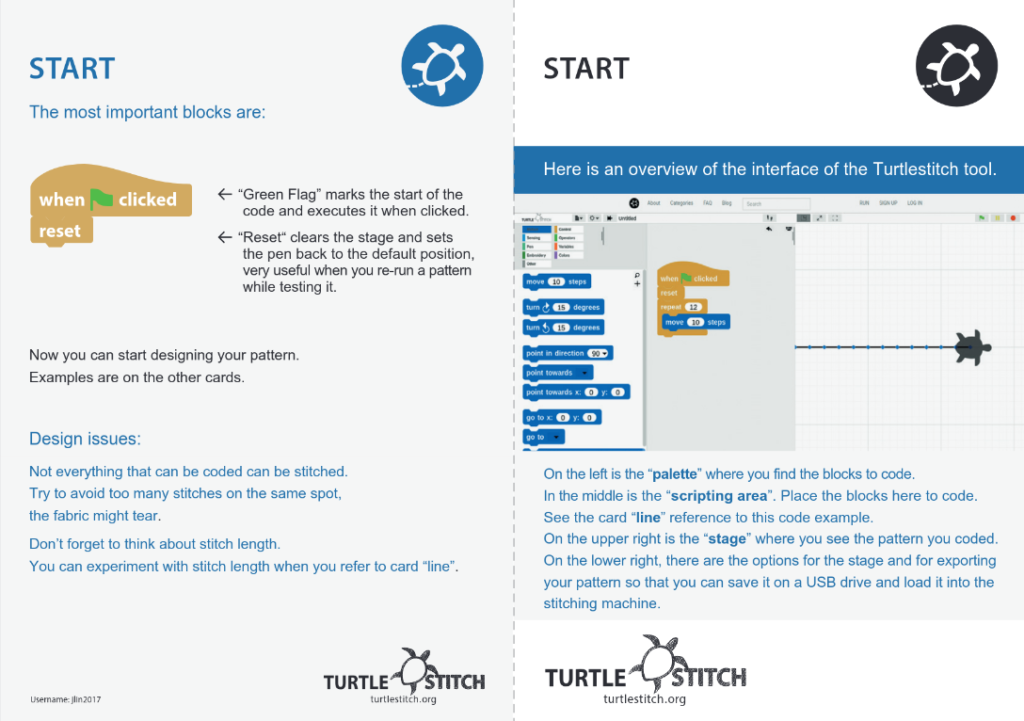
Beginner’s Cards in English
Download the Beginner’s Cards in A6 size / editable PDF
Credits for the cards go to Jennifer Lin and designer Tina Hochkogler.
We recommend checking out Jadga Hügle’s Introductory Manual Cards, published in 2024. They provide an introduction as well as more advanced instructions.
Summary of the topics covered
The TurtleStitch Beginner’s Cards provide an introduction to the TurtleStitch platform, covering essential concepts and tools for creating embroidery patterns.
Interface Overview
The interface consists of three main areas:
- Left: “Palette” with coding blocks
- Middle: “Scripting area” for placing blocks to code
- Right: “Stage” for viewing the pattern and export options
Basic Blocks
Essential blocks include:
- “When clicked” (Green Flag): Marks the start of the code
- “Reset”: Clears the stage and resets the pen position
Dimensions and Size
- The embroidery area size is limited by the machine
- Dimensions can be displayed in cm or inches
- The grid in the pattern window helps visualize size
- Scaling embroidery patterns can be tricky due to stitch density
File Formats
- Projects are saved in .xml format
- Blocks can be exported and imported (also .xml)
- Embroidery patterns are exported as .dst or .exp files
- Some machines may require file conversion
Code Organization
- Comments can be added to explain code sections
- Custom blocks can be created to simplify and reuse code
Embroidery Concepts
- Jump Stitches: Used to move without stitching
- Density Control: Avoid overcrowding stitches in one area
- Stitch Types: Various types available (e.g., running, zigzag, satin)
Basic Shapes and Patterns
The cards provide instructions for creating:
- Lines
- Circles
- Squares
- Pinwheels
- Flowers
Each shape introduces fundamental concepts like loops, variables, and custom blocks.
Programming Concepts
Through pattern creation, users learn:
- Loops (repeat blocks)
- Variables
- Custom block creation
- Basic geometry and math operations
Tips for Designers
- Consider stitch length (10 steps ≈ 2mm)
- Be mindful of pattern density
- Experiment with different stitch types and parameters

Leave a Reply